The RESCALE project’s overarching goal is to study physicists’ new scale-based theoretical practice through an in-depth integrated historical and philosophical study of contemporary physics.
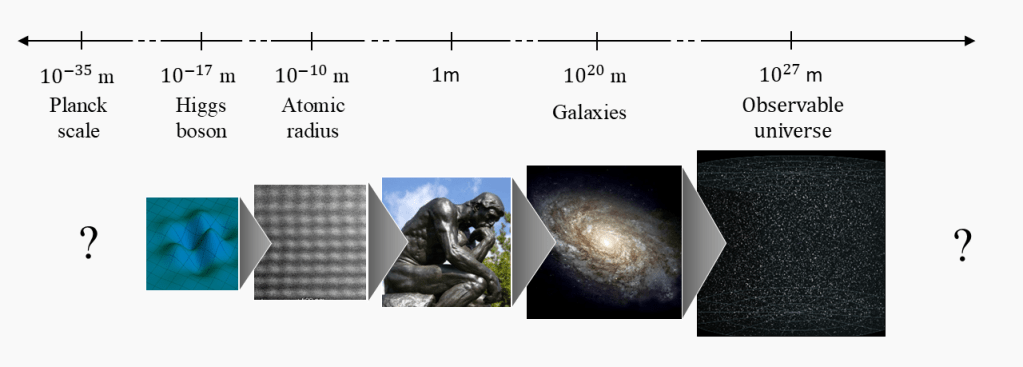
Historical part: The aim is to analyze the development of physicists’ new scale-based theoretical practice since the 1950s through the lens of effective field theories (EFTs) and renormalization group (RG) methods.
Overarching tasks:
- Examine why and how physicists have developed new scale-based theoretical tools since the 1950s;
- Evaluate whether the main research traditions associated with these tools have converged into a unified conceptual and methodological framework and identify their common interpretative core (if any).
Philosophical part: The aim is to examine the impact of physicists’ new scale-based theoretical practice on our world picture, using again EFTs and RG methods as case studies.
Overarching tasks:
- Clarify the concept of scale-relative representation afforded by scale-based theoretical tools;
- Assess the extent to which scale-relative representations are sensitive to each other across scales, and whether their content depends significantly on particular modeling interests and interpretative preferences;
- Unpack the partial and complex layered world picture provided by scale-based theoretical tools.
 RESCALE